GEO: getting cited by AI
Contents
GEO helps your site get cited by AI, those answer engines such as ChatGPT, Perplexity or Gemini that reply by giving their sources. Éclair already publishes the files they read: your part is to choose what you allow them to do and to write content that's easy to reuse. This lesson covers both, with the GEO score as your compass.
What you'll be able to do
Open your site to AI
Choose the bot policy, publish llms.txt and the Markdown versions.
Write to be cited
Key takeaways, a direct introduction, a FAQ and sourced figures.
Read the GEO score
Understand each check and fix a post.
What is GEO?
GEO, short for Generative Engine Optimization, helps answer engines (ChatGPT, Perplexity, Gemini, Claude, Google's AI Overviews) understand your site and cite it as a source. SEO aims for a good position in a list of results; GEO aims for a mention in the answer itself, with a link to you.
The basics are the same: useful, well-structured content written by someone identifiable. GEO adds three requirements: formats that are easy for a machine to read, direct answers at the top of the page, and precise facts that the AI can reuse without distorting them.
The files Éclair publishes for AI
| URL | Content | Setting in Settings › AI & GEO |
|---|---|---|
| /llms.txt | Your site's map for AI (llmstxt.org proposal): name, description, your business intro, then pages, products, posts and categories with their summary | Publish /llms.txt |
| /llms-full.txt | All your content in Markdown, in a single file | Publish /llms-full.txt |
| The page URL followed by .md | A clean Markdown version of every page, with title, description, author, dates and prices in the header | Markdown version of every page |
| /robots.txt | The rules for 30 AI bots | AI bots |
The first three are active from installation; the bot policy is the one you chose on the installer's “Visibility” screen. So Atelier Nova's classes page, /cours, also exists as /cours.md, and its home page as /index.md. Each Markdown version carries a noindex instruction and states the canonical URL of the original page: Google sees no duplicate content.
The Your business intro for AI field, in the same tab, is placed at the top of llms.txt: “it's often what AI remembers about you”. Write verifiable facts: who you are, what you offer, for whom, where, since when. For Atelier Nova:
Atelier Nova is a ceramics studio based in Lyon since 2012.
Wheel-throwing and hand-building classes for adult beginners, in groups of 6,
summer workshops and made-to-order pieces.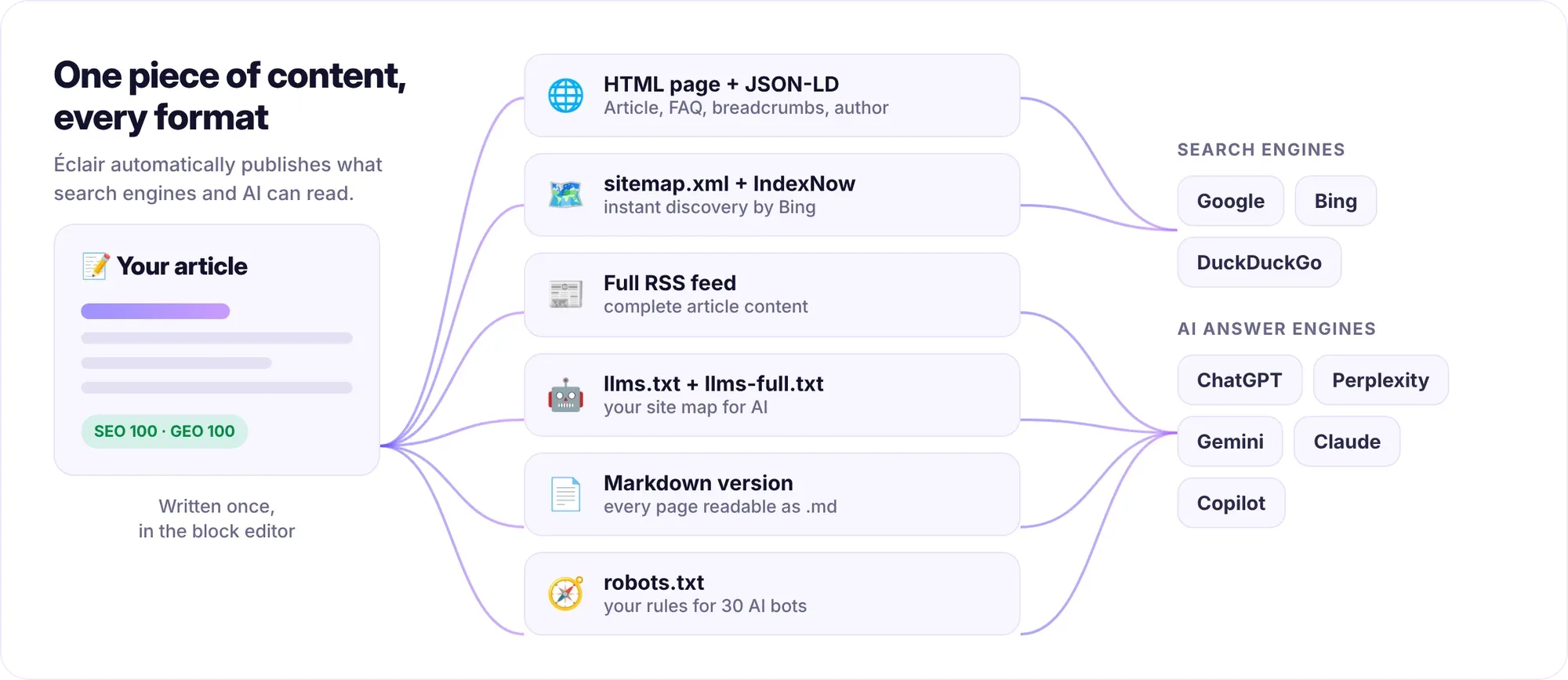
Which policy should you choose for AI bots?
In Settings › AI & GEO, the AI bots section offers three policies:
- Open, recommended: “Every AI can read and cite your site. Maximum visibility.”
- Citations only: “Answer engines can cite you, but can't train their models on your texts.”
- Closed: “No known AI bot is allowed. You disappear from AI answers.”
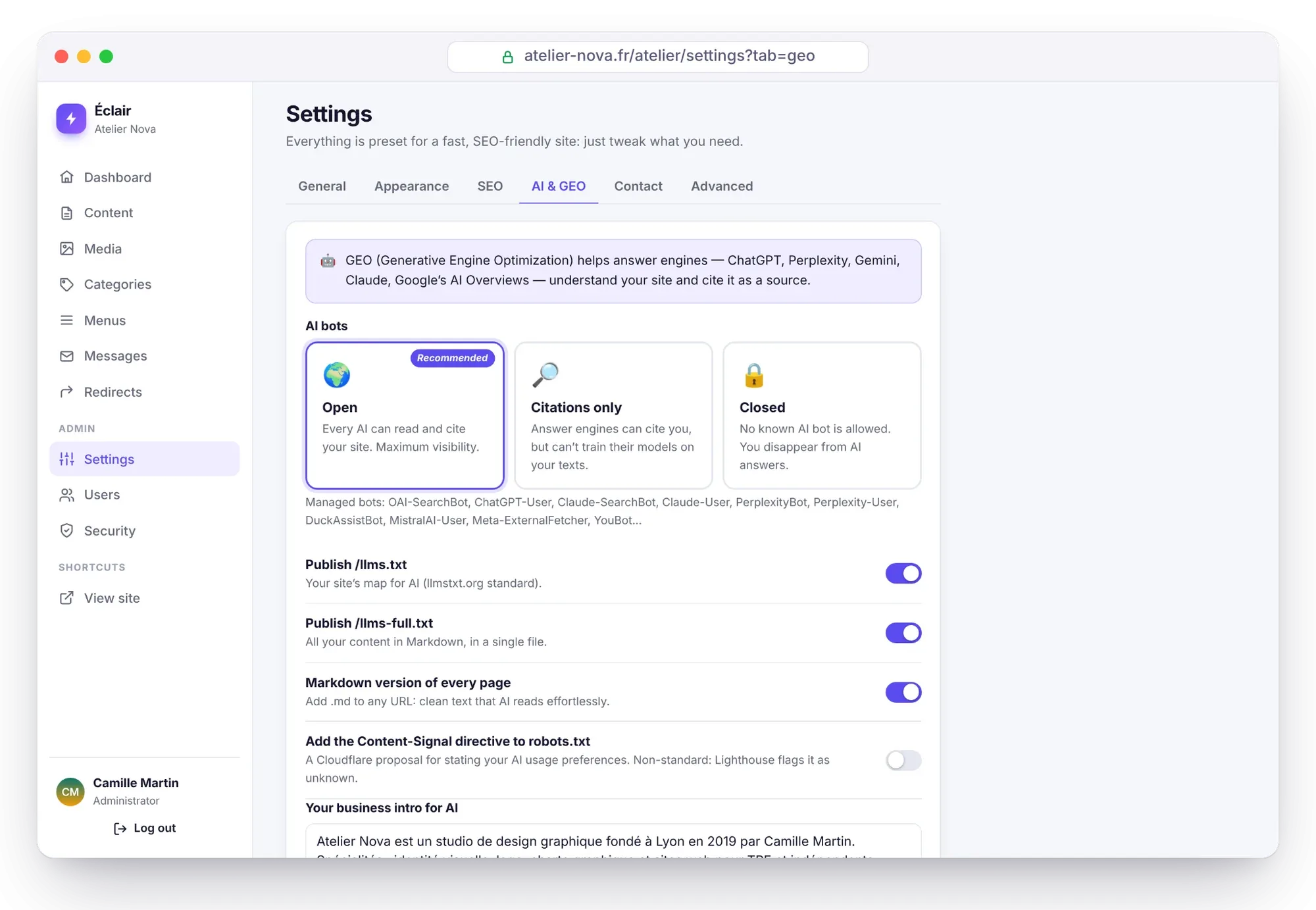
Éclair sorts 30 bots into two families: 10 answer-engine bots, which search or read a page at a user's request, and 20 model-training bots. The main ones:
| Bot | Company | Role according to Éclair | Allowed with “Citations only” |
|---|---|---|---|
| OAI-SearchBot | OpenAI | ChatGPT search | Yes |
| ChatGPT-User | OpenAI | On-demand reading | Yes |
| Claude-SearchBot | Anthropic | Claude search | Yes |
| Claude-User | Anthropic | On-demand reading | Yes |
| PerplexityBot | Perplexity | Answer engine | Yes |
| GPTBot | OpenAI | Training | No |
| ClaudeBot | Anthropic | Training | No |
| Google-Extended | Use by Gemini models | No | |
| Applebot-Extended | Apple | Training | No |
| CCBot | Common Crawl | Open training corpus | No |
| Meta-ExternalAgent | Meta | Training | No |
Google-Extended doesn't affect your ranking in Google Search: blocking it takes nothing away from your SEO. Atelier Nova chooses Open: a craft business has every interest in being recommended when someone asks where to learn ceramics in Lyon. Here's a shortened excerpt of its robots.txt with “Citations only” (Éclair writes the comment lines in French, whatever the site's language); the real file names all 10 and all 20 bots.
User-agent: *
Allow: /
Disallow: /recherche
Disallow: /_eclair/

# Moteurs de réponse IA : autorisés (citations et sources)
User-agent: OAI-SearchBot
User-agent: ChatGPT-User
User-agent: Claude-SearchBot
Allow: /
Disallow: /recherche
Disallow: /_eclair/

# Entraînement de modèles d'IA : refusé
User-agent: GPTBot
User-agent: ClaudeBot
Disallow: /

Sitemap: https://atelier-nova.fr/sitemap.xml
A robots.txt is an instruction that declared bots respect, not a lock. The Add the Content-Signal directive to robots.txt option also states your usage preferences, for example search=yes, ai-input=yes, ai-train=no with “Citations only”. It's a Cloudflare proposal, non-standard, that Lighthouse flags as unknown: that's why it's off by default.
Writing to get cited by AI
An AI readily reuses a short, clear and verifiable passage. Each good practice has its tool in Éclair:
- Key takeaways: in the editor, click Add “Key takeaways” and answer in 2 or 3 sentences, from 25 to 90 words. This summary is shown at the top of the post, goes into its structured data and opens its Markdown version.
- Direct introduction: 70 words at most, answering the question right away.
- Question subheadings, such as “How many sessions to get started on the wheel?”.
- FAQ block: marked up as FAQPage, it's widely reused by answer engines.
- Lists and tables: data that's easy to extract.
- Concrete figures and sources: a duration, a price, a percentage, with a link to the source.
E-E-A-T, author and freshness
Google sums up how reliable content is with E-E-A-T: experience, expertise, authoritativeness, trustworthiness. Answer engines also favor content whose author can be identified. In My profile, fill in:
- Job title / expertise, for example “Ceramicist and instructor since 2012”;
- Bio: at least 40 characters to pass the GEO score check, ideally your background and achievements;
- Photo and Your online profiles, one link per line.
This information appears below each post and feeds your author page and the Person structured data, with your profiles linked through sameAs. As for freshness, Éclair shows “Updated” when you edit a post more than a day after it was published, and the GEO score checks that the publication date is less than a year old. Update for real: a refreshed figure, an added section.
The GEO score, check by check
| Check | Green if… |
|---|---|
| Key takeaways | 25 to 90 words (the check that weighs the most) |
| Introduction | 70 words at most |
| FAQ | A FAQ block (posts and texts over 400 words) |
| Question subheadings | At least one, or a FAQ |
| Lists or tables | At least one |
| Concrete figures | A number followed by a unit (%, km, kg…) or at least two numbers of two or more digits |
| External source | At least one outbound link (posts and texts over 400 words) |
| Author | A bio of at least 40 characters |
| Paragraphs | None over 120 words |
| Freshness | Published less than a year ago |
Key points
- Éclair publishes llms.txt, llms-full.txt and a Markdown version of every page, with no setup.
- “Open” maximizes your visibility; “Citations only” refuses training but keeps citations.
- Key takeaways of 25 to 90 words are your most effective tool for getting cited by AI.
- An identified author, sourced figures and a FAQ make content quotable.
- The GEO score in the Analysis tab tells you what to fix.
Going further
- SEO with Éclair: the technical basics that GEO builds on.
- Blog, categories and topic clusters: author pages and internal linking that strengthen your credibility.
- 40 MCP use cases, with prompts: have Claude or ChatGPT write Key takeaways and FAQs.
- Sources: the llms.txt proposal and Google's guide to creating helpful, reliable content.
Frequently asked questions
Does blocking training bots make me disappear from ChatGPT?
Not with “Citations only”: search and reading bots such as OAI-SearchBot and ChatGPT-User stay allowed, and only training bots such as GPTBot are refused. With “Closed”, all of them are refused.
Is the llms.txt file an official standard?
It's an open proposal, described on llmstxt.org: nothing forces an AI to read it. Éclair generates it and keeps it up to date automatically, with no work on your part.
Do the Markdown versions create duplicate content?
No. Each .md version carries a noindex instruction and states the canonical URL of the original page: search engines index the HTML page.
Should I fill in Key takeaways on every page?
On every post, yes: it's the check that weighs the most in the GEO score. On a service page, it also helps AI sum up your offer in one accurate sentence.